






U.S. U-17 WOMEN: HISTORIC SCORER, QUARTERFINAL EXIT AND THE LESSONS AHEAD
With Maddie DiMaria scoring 12 goals and the United States eliminated by Korea DPR, the 2026 FIFA U-17 Women’s World Cup offered important evidence about individual talent and collective development.
A RECORD-BREAKING TOURNAMENT WITH AN UNFINISHED STORY
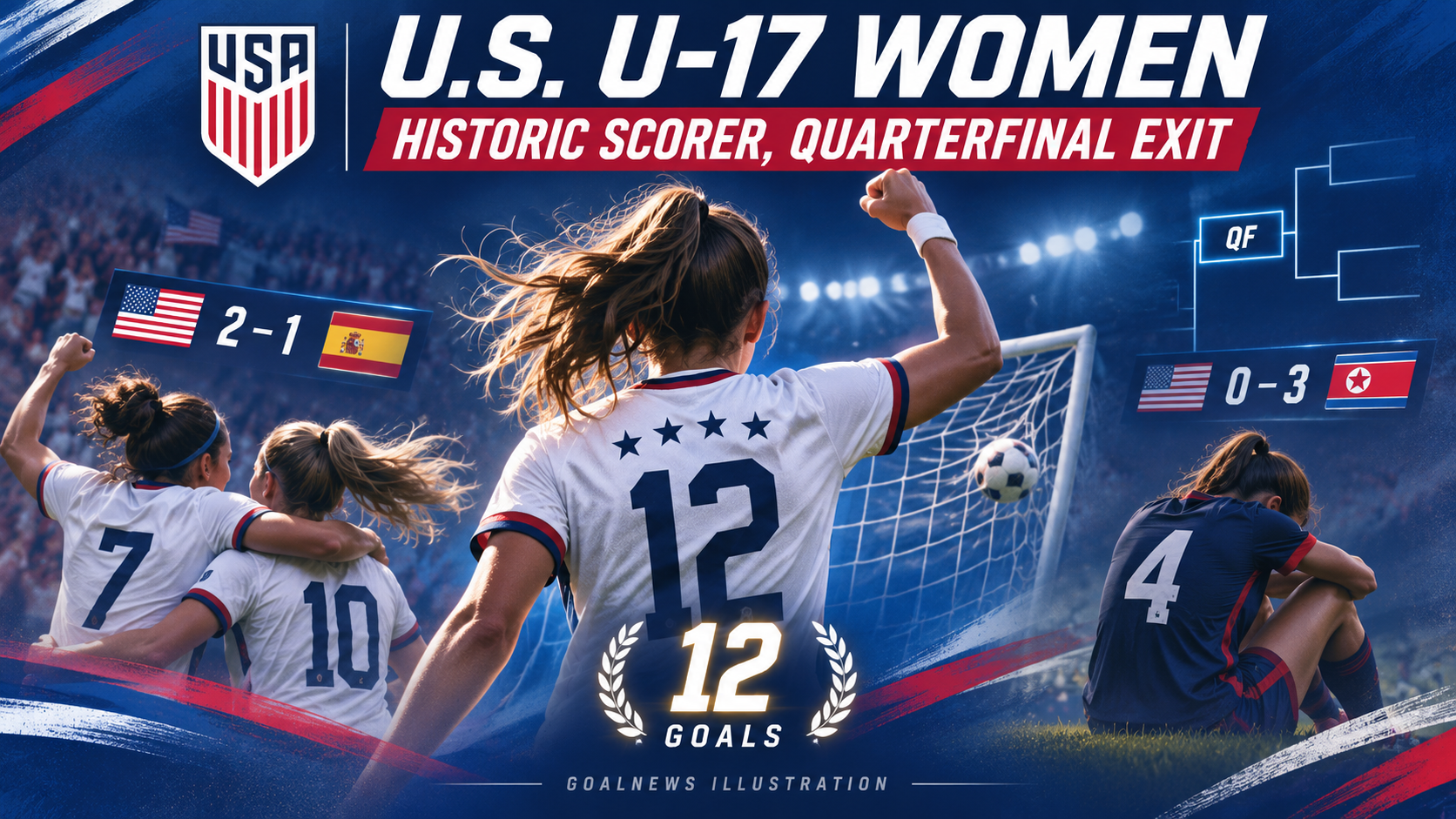
The United States concluded its 2026 FIFA U-17 Women’s World Cup campaign with an extraordinary individual achievement, a significant knockout victory and a disappointing quarterfinal defeat. Maddie DiMaria scored 12 goals, establishing a tournament record and emerging as one of the competition’s outstanding performers.
The Americans also defeated Spain 2–1 in the Round of 16 on October 29, with goals from Deus Stanislaus and DiMaria. But their campaign ended on November 1 with a 3–0 defeat against Korea DPR. The contrasting results raise an important question for American women’s soccer:
DIMARIA’S RECORD DESERVES RECOGNITION
DiMaria’s 12-goal performance demonstrated exceptional attacking potential. Scoring consistently at international level requires finishing ability, confidence and the capacity to recognize opportunities. Her achievement should be celebrated.
However, the development of a young international player cannot be measured by goals alone. As DiMaria advances, she will encounter increasingly organized defenses, faster decision-making demands and different tactical responsibilities. Her World Cup performance provides an encouraging foundation, not a guarantee of future senior-level success.
SPAIN DEMONSTRATED THE TEAM’S POTENTIAL
The 2–1 victory over Spain provided an important example of the Americans’ competitive ability. Stanislaus and DiMaria delivered the goals that advanced the United States to the quarterfinals. The result demonstrated that the team could produce a winning performance in a demanding knockout match.
It also made the subsequent defeat more significant as an opportunity for analysis. The challenge is understanding why the Americans could overcome Spain but struggled to compete effectively against Korea DPR.
THE QUARTERFINAL EXPOSED A DIFFICULT REALITY
Korea DPR defeated the United States 3–0 and outshot the Americans 33–5. The disparity illustrates how little attacking pressure the U.S. team generated compared with its opponent.
Goalkeeper Avellina Saunders made nine saves, including a penalty stop, providing one of the Americans’ strongest individual performances. Her contribution prevented additional scoring opportunities from becoming goals. But the number of saves also raises questions about the defensive workload imposed on the team.
The match warrants closer examination of midfield organization, ball progression, defensive transitions and the ability to respond to sustained pressure. The statistics establish the scale of the challenge. Detailed video analysis would be necessary to identify its specific tactical causes.
WHAT THE RESULTS MEAN FOR YOUTH DEVELOPMENT
The tournament demonstrated that American youth soccer continues to produce talented individuals. It also reinforced the importance of developing the collective qualities required for international competition.
Effective teams must create opportunities for their attacking players, maintain organization when possession changes and make sound decisions under pressure. These capabilities depend on coaching, competitive experience, technical preparation and tactical understanding.
The Korea DPR defeat should encourage further evaluation of those areas. It should not be interpreted as proof that an entire generation of American players has failed.
GOALNEWS PERSPECTIVE
The United States leaves the tournament with achievements worth celebrating and questions worth investigating. DiMaria’s scoring record, the victory over Spain and Saunders’ goalkeeping performance demonstrate individual and collective strengths. The quarterfinal defeat demonstrates that there is more work to do.
For GOALNEWS, supporting American soccer means recognizing both sides of that evidence. The objective is not simply to produce outstanding youth players. It is to develop teams capable of competing consistently against the world’s strongest opponents.
Celebrate the talent.
Examine the system.
Build the future.