





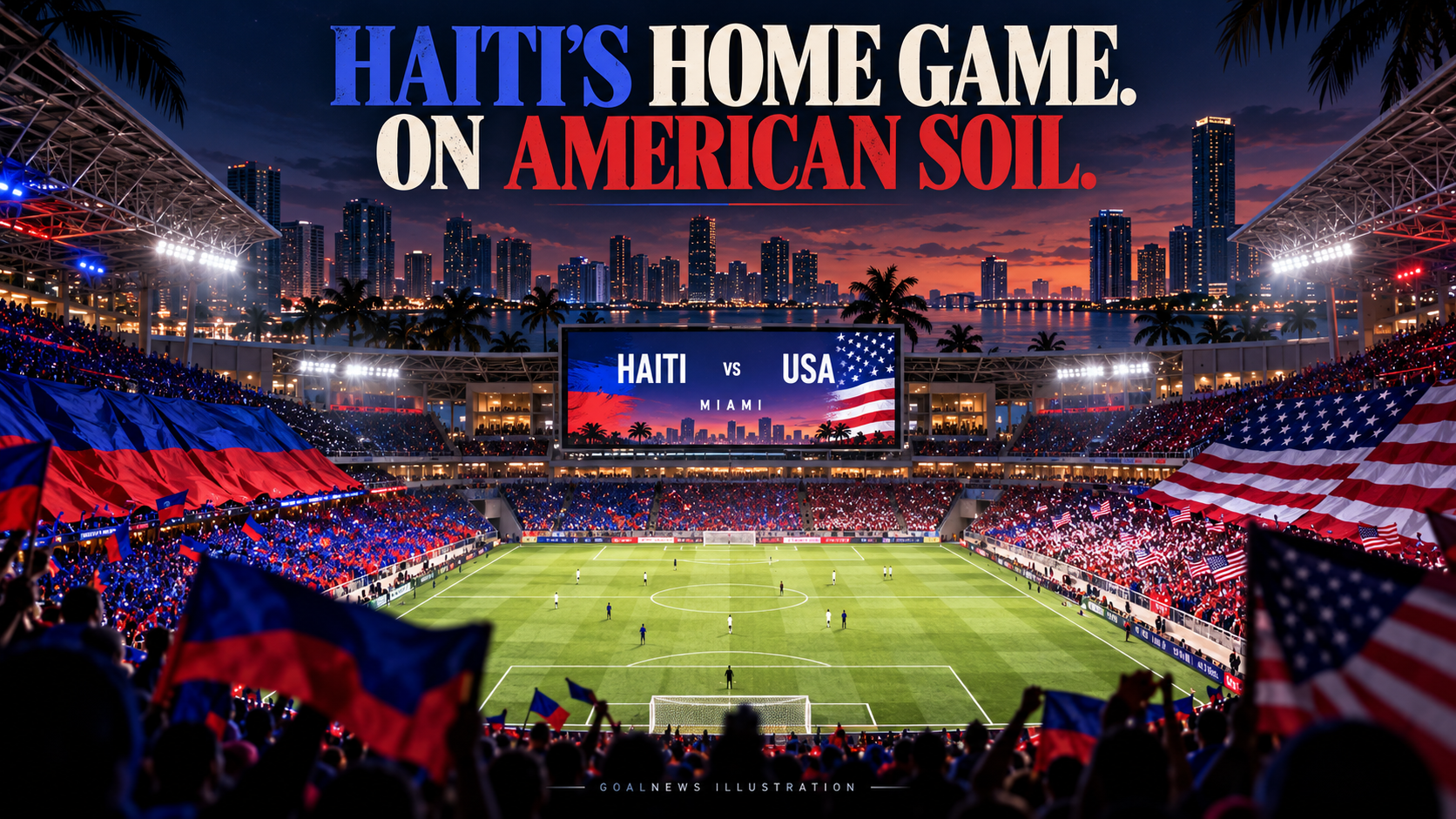
HAITI’S HOME GAME. ON AMERICAN SOIL.
Why Concacaf Moved Haiti’s Nations League Quarterfinal to Miami
Haiti will officially host the USMNT in Miami on November 14 before the return leg in Cincinnati. The unusual arrangement highlights the challenges of maintaining competitive fairness when security conditions prevent a nation from playing at home.
Nu Stadium — Miami, Florida
4:30 p.m. ET
Official home team: Haiti
TQL Stadium — Cincinnati, Ohio
7:00 p.m. ET
Official home team: United States
On November 14, Haiti will host the United States in the first leg of the 2026/27 Concacaf Nations League quarterfinals, but the match will not take place in Haiti. Instead, the two national teams will meet at Nu Stadium in Miami, Florida, at 4:30 p.m. ET. And three days later, the USMNT will officially host Haiti at TQL Stadium in Cincinnati, Ohio, at 7 p.m. ET.
Both matches will take place in the United States, although Haiti remains the designated home team for the opening leg.
The arrangement follows an exceptional decision by Concacaf and raises important questions about security, home-field advantage, and the responsibilities of international soccer governance.
Why Was the Match Moved?
Haiti has been unable to host international soccer matches on its territory because of the country’s continuing security crisis. The November 14 quarterfinal was originally scheduled for Sabina Park in Kingston, Jamaica.
However, the Haitian Football Federation formally requested additional flexibility to stage its designated home matches. On October 22, Concacaf announced that its Council had approved the request.
Under the new arrangement, Haiti may seek permission to host matches in the territory of its opponents rather than being restricted to venues within the Caribbean. The decision also applies to Haitian clubs participating in Concacaf competitions.
What Does the Exception Allow?
The arrangement is not unconditional. Each proposed match requires separate approval by the Concacaf Administration. The opposing federation must agree, and the selected stadium must meet the confederation’s requirements.
Concacaf has also retained the right to review, amend, or withdraw the exception. The flexibility will remain available while Haiti’s security circumstances continue to prevent normal hosting arrangements.
For the Nations League quarterfinal, Concacaf specifically approved Miami as the venue for Haiti’s designated home leg against the United States.
Is Miami Really a Home Advantage for Haiti?
The answer is more complicated than the location suggests. Miami is American territory, but South Florida has a substantial Haitian and Haitian American population. That creates an opportunity for Haiti to attract strong community support despite playing outside its national borders.
Earlier in 2026, Haiti attracted a sold-out crowd for a match against Peru at Nu Stadium. That experience suggests that the national team could receive meaningful support in the November quarterfinal. However, the size and composition of the crowd cannot be assumed before kickoff.
The unusual arrangement separates three elements normally associated with a home match: the team’s official hosting designation, the geographical location, and the support provided by spectators. In Miami, those elements may not favor the same team.
What Does It Mean for the USMNT?
For the United States, both quarterfinal legs will take place within the country. That removes international travel normally associated with an away fixture against a Caribbean opponent. It may simplify preparation and reduce some travel-related demands. But the USMNT cannot assume an automatic advantage.
Haiti remains the designated home team in Miami, and its supporters may create a substantial presence at the stadium. The Americans must still compete effectively across two matches, regardless of the unusual travel arrangements.
The second leg in Cincinnati retains the traditional designation of a United States home fixture.
The Governance Question
Concacaf’s decision responds to an exceptional security problem. Without alternative arrangements, Haiti would face continuing difficulties organizing the home matches required by international competition. Allowing flexibility helps preserve participation while recognizing conditions beyond the federation’s control.
At the same time, changes to hosting arrangements can affect travel, stadium familiarity, crowd support, and other competitive circumstances. That makes transparency and consistent regulation important. The requirement for individual match approval and agreement from the opposing federation provides a framework for evaluating each situation.
The challenge is to protect participants while maintaining meaningful competition.
The GOALNEWS Perspective
Haiti’s first-leg match against the United States demonstrates that the meaning of home-field advantage is not always straightforward. Haiti will officially host the match. The USMNT will play on American soil. And the crowd may include substantial support for the Caribbean national team. These are different realities, and none automatically determines the result.
Concacaf’s exception acknowledges that player and spectator safety must take priority when normal hosting arrangements are impossible. But the competitive implications still deserve examination.
Security comes first.
Fairness still matters.
On November 14, Haiti will be the home team.
Home, however, will be in Miami.